Celebration of Cashel King Cormacs Minor Footballers and Hurlers from 2000
Booklet can be viewed here.
Booklet can be viewed here.
Full article can be viewed here.
Full article can be viewed here.
Full article can be viewed here.
Full article can be viewed here
The passing of Timmy Moloney on September 30th, 2023 at the relatively young age of fifty years made his friends and acquaintances in Cashel, Tipperary and further afield reflect on the life of a hurling talent that was extraordinary and a playing career that brought excitement and memorable moments to all who saw him.
As a young boy the indications were obvious that Timmy possessed something special when it came to hurling ability. His first chance of revealing it was when he lined out with the under-12s in hurling and football in 1985. While the team didn’t enjoy any success Timmy revealed through his skill and his stature that he was a talent to be reckoned with.
His first real success at underage level was as a sixteen-year old in 1989, and it was in football rather than hurling. Cashel did qualify for the under-16 West hurling final but were beaten by Arravale Rovers. They had the consolation of defeating Emly in the Feile na nGael final. A sign of Timmy’s physical development, as well as his football ability, were his selection on the minor football team that went all the way to the county final. Cashel got revenge on Arravale in the West final, and Timmy played an important part in the victory. Arravale were two points up near the end when he netted to put Cashel ahead for the first time and become champions. The club went on to defeat Thurles Sarsfields in the county semi-final but lost the final to Fethard.
Timmy was on the successful West under-16 Garda Cup football selection that won the inter-divisional competition. He was also on the West under-16 hurling side that took part in the Munster competition. He was part of the West Tipperary panel of nineteen players, who attended a weekend hurling coaching course at Rockwell College in July.
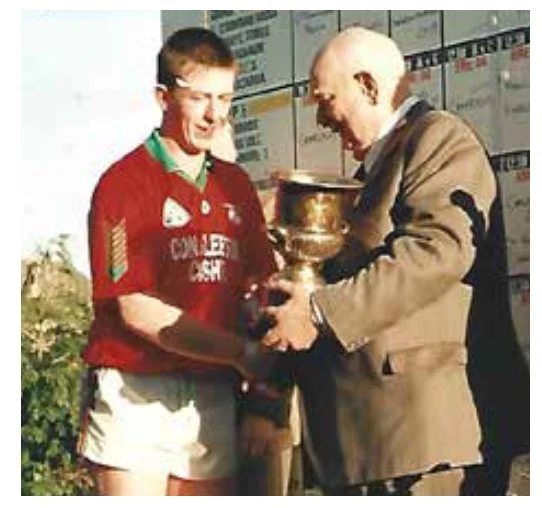
In 1990 Cashel minors had victory snatched from their grasp as the result of Ger Butler goal in the last minute. A sign of his growing stature as a player Timmy dominated at centrefield, scoring eight points of Cashel’s total of 1-13. He also played at under-21 level and was on the successful side that won the West final, with victory by 1-12 to 0-7 against Cappawhite-Eire Óg. Timmy played at centrefield and contributed three points to the winning total. Cashel won the double when they added the under-21 football title by defeating the same opposition by 2-7 to 1-2, with Timmy adding a point from his position at wing-forward. The winners didn’t stop there! Cashel defeated Eire Óg, Nenagh in the county semi-final by 2-9 to 2-8, with Timmy scoring a goal, and made history when they won the county final by beating the favourites, Clonmel Commercials, by 0-8 to 0-5, at Kilsheelan on January 13, 1991. Timmy played at full-forward on this historic occasion and scored a point.
To properly appreciate his achievements at this time, it is important to state that Timmy Moloney was still only 17 years of age, having been born in June 1973!
Timmy became part of Cashel King Cormac’s historic year when he was drafted into the senior panel in 1991 and contributed to the club’s greatest ever success. The West title was won by beating Cappawhite by 0-12 to 0-8 at Clonoulty on September 22. Victories over Carrick Swan and Toomevara qualified the team for the county final against Holycross at Semple Stadium on September 10 and victory by 2-8 to 1-5, with Timmy introduced as a sub. It was then on to Ennis for victory over Clarecastle, and Mitchelstown for an historic Munster club championship victory. This was followed by the excitement of a trip to London for a successful encounter with Sean Treacy’s in the All-Ireland series, followed by three games against Kiltormer, which ended in defeat. In the latter series of games Tim was on the bench at Cashel, won the Man of the Match for a tally of 1-4 at Ballinasloe, and also played in the 2-8 to 1-8 defeat at Croke Park.
Timmy added an under-21 county title to his list of successes in 1991 when Cashel trounced Cappa-Eire Óg in the West final, Timmy contributing eight points, and defeated Erin’s Hope in the county final to take their first ever county final at this level. Timmy was on the panel of the Tipperary minor panel that won the Munster final but lost the All-Ireland.
Cashel were aiming for a third senior title in a row at Bansha in 1992 but lost by 2-15 to 1-11 on a day that Timmy scored six points. There was a second senior loss to Loughmore in the county quarter final. There was even greater disappointment in the county minor hurling final when hot favourites, Cashel, lost by 1-12 to 1-7 to Moneygall. Timmy’s contribution was 1-2 on the day. Timmy was captain and one of four Cashel players on the county under-21 side that went down badly to Clare in the Munster semi-final at Ennis on June 17. Playing at centre-forward, he scored two points of the side’s total of 0-13.
There was one success that year. Cashel entered the Carlow Elevens for the first time in 1991 and won the Shield competition. They went one better in 1992, when they won the competition proper. Timmy was on the successful team.
Timmy made a major decision in 1993 when he departed for London. He was still only nineteen years of age and had already revealed such a special talent that he was on the threshold of becoming a member of the Tipperary senior hurling panel. He had all the attributes of a senior player, a fine physique, an extraordinary level of skill with the ball in hand, the ability to reach into the air and catch the ball with either hand, a high level of commitment. On top of that he had a lethal stroke of the sliotar. I have spoken to backs and goalkeepers who played against him and they preferred to be any place but between the posts for his twentyones. His shot didn’t swerve left or right but went straight at you like dagger!
Timmy soon settled into life with the Sean Treacys G.A.A. club and his achievements with them are spectacular, including 3 senior championship wins in 1993, 1994 and 2002, 4 Seven-A-Side Great Britain championship wins, 4 Collins Cup wins, 3 Ryan Cup wins, 4 senior league wins. He also represented London and played in the Ulster championship against Antrim, scoring 10 points on the occasion and receiving the Man of the Match award. He also made the G.A.A. Team of the Week after that performance. Awards included 2 Player of the Year awards from the Sean Treacy Club, the Irish World London Player of the Year award 1999. The citation read: ‘I’ve never seen a more accomplished player in London. His fielding and free taking from any distance was a sight to behold.’
Timmy did return home during these years following a letter from Cashel trainer, Justin McCarthy, in 1995. He was part of the Cashel team that made it three in a row West senior hurling championships, when they defeated Kickhams in the final. Timmy contributed 7 points to the winning total of 2-11 to 0-10. He was the individual star when Cashel beat Loughmore in the county quarter final, and he scored 1-11 of Cashel’s total in the semi-final, when they agonisingly lost by a point to Nenagh Eire Óg. In the same year Timmy was part of the Cashel team that had their second victory in the Carlow Elevens. Following his displays Timmy was drafted into the Tipperary side for the early league games at the end of the year. The year 1996 wasn’t as successful. There was a win in the Crosco Cup, defeat in the West final and Cashel were blitzed by Boherlahan in the county semi-final. Timmy had the consolation of winning the Carlow Elevens for the second time, in this case as captain and as top marksman in the competition with the impressive tally of 4.20! He returned to London by the end of the year.
When he came back to Cashel in 2003 and to play with Cashel King Cormac’s once again, Timmy turned his hand to the future generations, guiding many underage teams to success, including his son, Daniel. Not only was the G.A,A, club the benefactors of his coaching prowess, he also worked with teams in Cashel Camogie club, and brought them successes including Community Games, under-14A county and Munster champions 2017, plus county under-14 A summer league, championship and Feile wins in 2018. The highlight for Timmy must have been the hat-trick of goals scored by his daughter, Ciara, in the championship final!
During these years Timmy also played rugby and contributed to some of the successes of Cashel RFC including winning Junior and Challenge Cups alongside his brother, Barry, in 2005.
Timmy’s contribution to the sporting life of Cashel, Tipperary and London has been immense. Wherever he performed he left an imprint and a memory and tales of his exploits and his lethal stroke of a sliotar will be remembered by many.
PDF of this article is available here.
( I’m grateful to a number of people, particularly Eileen Moloney, (Martin Carroll in London) and Donal O’Donoghue, for their contributions to this article.)
Ardmayle Cemetery, June 7, 2025
Since hearing of Michael’s death on Thursday one image keeps flashing in my mind. It is of a group of people outside Granny’s kitchen on a beautiful Sunday morning in 2002. In the centre of the picture is the imposing figure of G.A.A. President, Joe McDonagh, who was on a brief visit to Cashel and the most appropriate place to meet him was in the shadow of the Rock and where we could enjoy the hospitality of the O’Dwyer family.
The G.A.A. President’s visit was brief but it was a recognition of the achievements of the club and its contribution to the G.A.A. in general. Of course I have to add it had something to do with the fact that a Galway man, was secretary of the Cashel King Cormacs!
In contrast, today we are witnessing a more sombre picture, the interment of a past chairman of the club, Michael O’Dwyer. But I believe there is a connection. During the years of Michaels’ chairmanship, 1980-1984, the improvement in the club’s achievements that came to fruition in the early nineties, can be seen.
Michael got involved with the club in the late sixties, when his son Liam was part of that outstanding under-13 side that qualified for the county final in hurling and football, winning the latter but beaten by Ballina in the hurling. That side formed the basis of the outstanding success through most of the 1970s
Following his involvement with the juveniles in coaching and selectorial roles, Michael was elected to the senior committee in the late seventies and became chairman of the club in 1980, succeeding Jim Sullivan. His first year as chairman was a hectic one. It marked the 50th anniversary of the establishment of the West Board, which was celebrated in an appropriate manner. It included a visit of GAA President, Paddy McFlynn to Cashel and a presentation to him by Michael. More importantly the King Cormacs defeated Sean Treacy’s in a replayed West final. An even greater achievement was the winning of the county minor championship, beating Thurles Sarsfields convincingly in the final, and to add cream to the achievement, the under-16 hurlers also won the county championship beating Toomevara in the final.
During these early years of the 1980s the hurlers in the CBS were flying under the baton of the aforesaid Galway man, and won two All-Ireland B College hurling titles. Training facilities were very important for the preparation of the team. This was the time when Cashel King Cormacs weren’t in control of Leahy Park but Matty is very appreciative of the efforts that Michael made in these years to ensure that the CBS had the facilities of the park for training.
It isn’t possible to recount all the achievements of the late Michael O’Dywer, but two stand out with distinction. The first of these was the introduction of a club constitution in connection with Martin Quirke. This was a major innovation as it was the first time Cashel King Cormac’s club had a system of rules and basic principles by which the club is run. Its existence safe guards the members as well as the existence of the club.
The second of these was the refurbishment of Leahy Park for the hosting of the 1983 county senior hurling final between Borrisleigh and Loughmore Castleiney. It was prevented from taking place in Thurles because of the refurbishment of the stadium for the 1984 All-Ireland final. It was a brave decision to host the final as the facilities in Leahy Park were primitive by today’s standards at the time. But, everything went off without a hitch.
Michael O’Dwyer’s contribution to the Cashel King Cormacs and to the G.A.A. in general was recognised when he was honoured with a Laochra Ghael Award in 2009. In the citation, following the listing of some of his achievements, it stated: ‘Michael had the capacity to surround himself with a good team of clubmen whom he knew would move forward any project to a successful conclusion. On the social side of things he was instrumental in organising some of the most successful club socials during the 1980s and in leading club tours to London. During his time as chairman, the King Cormacs were trend setters in producing a club history. Stepping down as chairman at the club AGM in Centenary year, Michael was described as a moderate and calm club chairman.’
In conclusion I want to extend the sympathy of the Cashel King Cormacs to the O’Dwyer family and express the club’s thanks for Michael’s contribution during a long lifetime.
Full article can be accessed by clicking here.
Full article can be accessed by clicking here.
Full article can be accessed by clicking here.
Full article can be accessed by clicking here.
Full article can be accessed by clicking here
Presentation Booklet for the Annerville Awards at Clonmel on January 25, 2025
The number of handballers from Cashel who were honoured by the Tipperary United Sports Panel in the Cidona/Annerville awards down the years reflects the strong tradition of the game in the town. According to Albert Carrie, the game was played in Cashel as far back as 1850 when the members of the RIC had an alley in Hogan Square and they forbade the locals from playing in it. Those who did were issued with summonses. When the GAA was founded, it tried to foster the game by establishing an alley in every parish, but it was 1935 before an alley was built in Cashel on what is now Dean Ryan Terrace. It captured the interest of many players and great games took place, as it developed into the most popular outdoor recreation place in town. When the alley was knocked down in a hurricane in 1960, it put an end to handball in Cashel for a time.
New Alley
It took until 1975 for a new alley to be built. The amount raised by a fundraising committee wasn't sufficient, so it was decided to build it by direct labour, under the direction of Albert Carrie. The work began on Holy Thursday and was completed in less than six months and the alley was officially opened by Brother Malone on October 26, 1975. It was named after Monto Carrie, a well-loved supporter of all local endeavours, who died in a car accident in August 1973. The alley became a great centre for the promotion of handball in the town and in a short time success came to the club. In 1979 John O'Donoghue and John O'Neill won the All-Ireland Under 15 title, and Jimmy O'Neill and John J Murphy won the Under 18 title. In 1980 John Scannell and Richard Fahy won the All-Ireland Doubles Under 17, and on the same day John Scannell teamed up with Jimmy O'Neill to win the All-Ireland Under 18 Doubles. There were other successes in the Vocational Schools competition.
Spectacular Success
The number of successes is too many to mention in this short article, so I will concentrate on John O'Donoghue's achievements, which were spectacular. In 1980 he was beaten in the All-Ireland Singles final by P. McCann of Sligo, but came back in 1981 to beat his opponent of the previous year. In the same year, along with John Fitzell, he lost the All-Ireland Doubles final. In 1982 John O'Donoghue lost the All-Ireland Singles final to Ducksy Walsh, but there was consolation when he and Fitzell defeated Walsh and his partner in the All-Ireland Doubles final. In 1982 John won the All-Ireland Minor singles hardball final, and repeated the success in 1983. In the latter year he also won the All-Ireland Doubles with Eddie Corbett. In 1984 John won the All-Ireland Under 21 Doubles with K. Mullins. In 1985 he won the All-Ireland Under 21 Singles and the Doubles in partnership with Eddie Corbett. There were further successes in 1986, when there were two Under 21 Doubles All-Irelands, a Junior Singles and a Junior Doubles. Junior Doubles followed in 1989 and 1990 and Senior Doubles in 1991.
Back Injury

At this stage John's back was injured and he had to retire from handball. He returned in 2016 to win a Golden Masters Doubles, and repeated the achievement in 2017. A Silver Masters Doubles 60 x 40 was won in 2018, as well as a Golden Masters 40 x 20. There was much more that this outstanding handballer won, and he was the first Cashel person to win a Cidona Award when he won the Handball award with Kevin Mullins in 1984. He followed up with a second award, alone, in 1985, a third with Eddie Corbett in 1991, and a fourth when the two succeeded again in 1992. The nearest he came after that was when his son, Paraic, won with Daniel Hayes in 2016.
John O'Donoghue set the standard for others, women as well as men, in the Cashel club. David Moloney won the award in 1992, Carol Moloney in 1995, Jackie Keating and Carol Moloney in 1997, Daniel Hayes and Coilin Ryan in 2012 and Daniel Hayes and Paraic O'Donoghue in 2016
Presentation Booklet for the Annerville Awards at Clonmel on January 25, 2025
Thomas Glendon has been designing the Knocknagow Award for 45 years. He recalls being contacted by Maurice Durney from Showerings, Clonmel in 1979. The contact stemmed from a recommendation by Apple Advertising, who were looking for an artist to explore and produce ideas for a series of sports awards.

Johnny O'Loughlin is the longest-serving member of the United Sports Panel. He joined the panel in 1976 and recalls that there was no specifically-designed Knocknagow Award before 1979. The panel usually contacted a provider to supply trophies for the recipients, with a bigger one provided for the Knocknagow Award. There was a lack of consistency in the design and quality
Johnny O'Loughlin is the longest-serving member of the United Sports Panel. He joined the panel in 1976 and recalls that there was no specifically-designed Knocknagow Award before 1979. The panel usually contacted a provider to supply trophies for the recipients, with a bigger one provided for the Knocknagow Award. There was a lack of consistency in the design and quality of the trophies.
Thomas Glendon's brief was to design a major award, Knocknagow, for a Tipperary sports star of the past; and a secondary award, named the Cidona Awards, for established and emerging athletes. There was no restriction on the field of sport and over the years a broad range of activities, including Gaelic football, hurling, soccer, rugby, boxing, athletics and showjumping were to receive recognition.
Considering the brand and products produced by Showerings, a motif based on an apple appeared the most appropriate design for the Knocknagow award. At an early meeting at the design stage an apple in marble was suggested, but when a request emerged for it to be sprayed silver, the idea was dropped. Thomas Glendon explains his intention: “In my modelling of the award I felt an apple in the round would be too much in volume. This led to the process of paring and decoring to arrive at a satisfactory shape. To an untrained artistic eye it had to immediately convey its source of firm, distinctly apple and not easily mistaken for another fruit. The success was in the outline, it conveyed an apple without all the weightiness.
“The award is made of bronze, cast in a sand mould, polished and patinaed. In the raw the metal is cased and filed to define the outline, then the edges are patinaed and the face given a high polish. Elevated on a bronze dowel, it is set on a polished base made of Kilkenny limestone”.
The original Cidona Awards, now ceased, were medallions of sterling silver, echoing the Knockagow in outline.
Thomas Glendon hails from a line of long established monumental masons in the Dun Laoghaire district, who originally came from the Inistioge area of Kilkenny in the 1880s.
His introduction to craftsmanship in stone was in his father Laurence's workshop at Deansgrange, County Dublin. Under his guidance he learned the primary techniques in stonework, geometry, lettering and toolmaking. Sometime later he was introduced to the well-known letter-cutter and sculptor, Michael Biggs.
The 1916 Proclamation carved on Ardbraccan Limestone at Arbour Hill is his masterpiece in lettering. He also had a very successful and influential body of work in Sanctuary Furniture design; St. Michael's Church, Dun Laoghaire and St. McCartan's Cathedral in Monaghan are well-known examples of his approach to sacred elements.
Thomas was Michael Biggs' assistant for six years, from 1968-1974, when he received an excellent grounding in the fundamentals of letter design and model-making.
They parted on good terms and Thomas set up his own studio in Shannon, County Clare, learning the rudiments of the self-employed.
In fact, while in Shannon the request to design the Knocknagow award came about.
He has fond memories of travelling through the Glen of Aherlow to meetings in Clonmel.
Presentation Booklet for the Annerville Awards at Clonmel on January 25, 2025
This year we celebrate the 60th anniversary of the sponsorship of the Tipperary United Sports Panel Awards by Bulmers.
In connection with the presentation of the 1964 awards in the Ormonde Hotel, Clonmel on January 31, 1965, a large advertisement appeared in The Nationalist newspaper announcing the sponsorship: 'The Irish Cider & Perry Company Ltd salute the Tipperary Sports Stars of 1964 and are pleased to sponsor the Cidona Trophies'.
This was a major coup for the original members of a group of men, who assembled in the Slievenamon Hotel on December 12, 1959 with the object of promoting sport throughout Tipperary by the annual presentation of awards to selected stars. The group, which included Sean Cleary, Sean Lyons, Sean Barlow, Bill Hyland, Christy Mulcahy, Eddie O'Neill Bill O'Brien, Paddy Cummins, Ken Hogan, Tom Halpin and Ted Dillon, adopted the name, United Sports Panel, and presented their first awards in St. Patrick's Hall in Clonmel on January 17, 1960.
The sports honoured were camogie, soccer, table tennis, sports executive, athletics, cycling, hurling, basketball and Gaelic football. Each winner was presented with a cup and, in the course of his speech introducing the stars at the presentation, Sean Lyons thanked those who had donated trophies.
The need to have regular presentation trophies for the stars was a problem for the panel. It became more urgent in 1962, when the panel made an important addition to the awards with the decision to honour an outstanding sportsperson from the past to the list of recipients. They gave the name Knocknagow to this award and by its very nature something special was required.
The advent of the Bulmers sponsorship was timely, as it afforded the panel the opportunity to provide suitable trophies of regular design. However, the range of trophies presented could differ from year to year and the need for something more permanent was required, especially for the Knocknagow Award. Cidona Awards
Bulmers took the initiative in 1979 when Maurice Durney from the company contacted Thomas Glendon about designing a suitable trophy for the Knocknagow Award and a secondary award for the Cidona Awards for established and emerging athletes. Considering the brand and products produced by Bulmers, a motif based on an apple appeared the most appropriate.
And so, permanent trophies became the norm in the presentation of the awards. The awards for the stars continued to be presented until a number of years ago, when the panel had a new award designed by John Quirke of Cahir.
Annerville Award
The association of Bulmers with the awards was made permanent with the adoption of the Cidona name for the awards from the advent of the sponsorship. The name continued to be used in the awards until 2007, when the name was changed to the Annerville Awards. The Cidona brand was no longer held by Showerings Ltd, the parent company, so the name Cidona could not be retained as the name for the awards. A new name had to be found and the one chosen was Annerville, the name of the townland near Clonmel where the company is located.
So, after 42 years of the Cidona Awards, they were called the Annerville awards in 2007, and presented as such at the presentation dinner at Hotel Minella on February 2, 2008.
The two names, Cidona and Annerville, indelibly connect the United Sports Panel with Bulmers and the Showerings company and reflect the long connection between a bunch of sporting enthusiasts and a local company, both with a love for and a desire to promote Tipperary sport at heart.
Johnny Fogarty, December 2024
Booklet can be found here
Full article can be found here.
Full article can be found here.