Memories of Galway v Kilkenny in the 1947 All-Ireland Semi-Final
A Cradle of Hurling; Stories from Southeast Galway by Aidan Lenehan
“Mind the child!” roared the voice, “Mind the child!”, it repeated. The scene was the exit gate of St. Brendan’s Park, Birr after the All-Ireland Senior Hurling Championship semi-final between Galway and Kilkenny on 27 July 1947.
I was the child, a mere eight year-old, bordering on nine, in a crush of men, including my father, seeking to exit the field after a thrilling game that saw Kilkenny swipe victory from Galway in the last minute. I don’t remember any fear for my safety just excitement and a feeling of importance at being in the midst of so many on such an exciting occasion.
Later, the newspapers told us that 23,250 fans had paid £2,021 8s 3d to see the match. I don’t know what the seating capacity of the venue was, but I recall we were on the sideline. We must have arrived early, because the sideline was closed long before the first match, the minor semi-final between Galway and Dublin. I had a perfect view, lying on the grass close to the play for the duration of the game.
Some Details
I don’t remember many of the details of the match. The parade beforehand stands out. It included two bands, the Birr St. Brendan’s Pipe Band and the Nenagh Brass Band. I expect we were shouting for Galway as we lived beside the River Shannon, and my mother did most of her shopping in Portumna. The names of some of the Galway players stood out. Seanie Duggan was the outstanding goalie in the country at the time and his dominance in the position led to Mullagh’s Tony Reddin, another goalkeeper, leaving the county and crossing the Shannon to Lorrha earlier in the year for a stellar career with Tipperary. Josie Gallagher was another familiar name. Others to stand out were John Killeen and Hubert Gordon, as well as Fr. Paddy Gantley, who played under the name, P. Gardiner! The Kilkenny names were less familiar but those that registered included Sim (Simon Francis) Walton, Jim Langton, Paddy Grace and Terry Leahy.
Galway were hopeful of victory on the day. They had lost badly at this stage in Birr the previous year, when they were walloped by Cork, 2-10 to 0-3. But a better memory was of their display at the same stage in 1945, when they held Kilkenny to a point, 5-3 to 2-11, at the same venue. What really built up expectations in the Galway camp coming up to this semi-final was their great displays in the Railway Cup games earlier in the year. Connacht, which was all Galway, defeated Leinster in the semi-final by 2-6 to 2-5, and Munster by 2-5 to 1-1 in the final.
One succinct account of the game from a Galway point of view was that given in the report of the match in The Connacht Tribune: “Although they spent half an hour proving that they were at least as good as Kilkenny and most of the remainder of the hour proving that they were beyond doubt the better side, the Galway senior hurling selection made Kilkenny a present of the right to enter the All-Ireland final. It was a present that was served out on different platters. There was a defensive slip within two minutes of the start that let Kilkenny through for a goal; there was a weakness in one of the Galway back positions and two forward berths and there were three or four points thrown away by Galway. Apart from these things it was a game of hard, fast and at time brilliant hurling; it was a game of thrills climaxed by a great shock for Galway and a lucky win for Kilkenny.”
A Close Encounter
The game was a tight contest in which Galway were slightly ahead by a point, 1-5 to 1-4 at half-time. Their performance improved in the second half, and they were ahead at the end of normal time by a point. At this point, when the whistle was blown for a free, the Galway supporters rushed on to the field to embrace their heroes, believing it was the final whistle, only to learn the whistle was for a free to Kilkenny. This was a shock for the supporters who were ordered back to their seats and the free resulted in the equaliser for Kilkenny. Galway were off balance then and in the closing minute Kilkenny added to their tally, when Jim Langton sent over for the winning score by 2-9 to 1-11. It was an excruciating ending for Galway supporters.
The Galway lineout was as follows: S. Duggan (capt), Jas. Killeen, P. Forde, W. Fahy, M. J. Flaherty, J. Brophy, B. Power, P. Killeen, John Killeen, T. Kelly, H. Gordon, P. Gordon, J. Gallagher, S.. Gallagher, M. Nestor. Subs: D. Flynn, J. Coen, B. Hanniffy, M. Glynn, S. McNamee, P. McNeill, P. Tully, J. Jordan, T. Callanan.
Kilkenny: J. Donegan, P. Grace, P. Hayden, W. Walsh, J. Kelly, J. Prendergast, M. Marnell, D. Kennedy, J. Heffernan, J. Langton, T. Leahy, S. Downey, T. Walton, P. O’Brien, L. Reidy. Subs: P. Lennon, L. Kelly, P. Fleming, J. Egan, W. Dunne, M. Neary, J. Mulcahy.
Both teams had complaints about the referee. The man who was in control of the game was Dinny Costello of the Shannon Rovers Club in North Tipperary. He was a major figure in his club, having held most positions including that of chairman. He was also a referee, and it is believed that Seamus Gardiner, who had been President of the G.A.A. from 1943-46, was instrumental in his appointment. Gardiner, who was from Borrisokane, would have known Costello well and, with the match in Birr, he would not have been a surprise choice. It is also significant that Gardiner and Costello were elected as North Board representatives to Congress at the 1948 divisional board convention.
The Galway supporters believed the referee had allowed too much added time and it was during that additional period that Kilkenny got the scores that gave them victory. They vented their fury on him after the game, heaping abuse on him as he left the field. He had to be protected by the Gardai. (There is a belief in Shannon Rovers that some Galway supporters called to Costello during the week following the match to apologize for their behaviour!)
Unsportsmanlike Conduct
But Kilkenny weren’t happy with the referee either. At a meeting of the Kilkenny Corporation the week after the match, strong protests against what was described as the unsportsmanlike conduct of the Galway team were expressed when a resolution congratulating Kilkenny was passed. One speaker, Mr. J. Magennis, said there were certain players on the Galway team who, he was sorry to say, were not a credit to the Association. Another speaker, Mr. J. P. Pattison stated that: “Some things happened at Birr, which called for very definite action, and those found guilty of participation in those acts, should be debarred from taking part in future games.”
These aspersions on the Galway players weren’t well received at the next meeting of the Galway G.A.A. Board. The chairman had this to say. He had hoped that the Kilkenny G.A.A. Board would have rejected the allegations, but they had not. He added: “I think that if the Kilkenny Corporation paid more attention to housing than to matters concerning the G.A.A., they would be much better serving the interest of the ratepayers.”
In the course of the discussion the referee came in for criticism. Mr P. Naughton, chairman of the North Board was critical of the referee. He stated, “that if they had had a proper referee they would have ‘walked the match.’” He wanted to know who asked for this particular referee.
At this stage the secretary, Mr. S. Ó Faolain, said that the referee wasn’t asked for. Willie O’Donnell was the referee requested and the one appointed was only the second choice.
The discussion went on to other matters. Galway might have objected to Kilkenny’s victory as they hadn’t submitted their list of players to the referee until after the game. He also revealed that Nenagh might have been the venue for the game.
An interesting letter appeared in the Kilkenny People on 16 August in response to the allegations of dirty play by Galway: “Sir: I read a lot in your paper about the Kilkenny Corporation’s description of hooliganism on the part of Galway in the Birr match, but I attended a match at Nowlan Park last Sunday between two Kilkenny teams and there was stuff served up there both between players and spectators that left Birr in the shade.” The letter was signed: A Man from the West.
Conclusion
So, was the game as bad as it was painted by Kilkenny? I am unable to give an opinion. The following was that of a neutral observer: “The game was unduly rough at times: several players had head injuries, which was a sign that the rules weren’t strictly observed.”
What was memorable about the occasion, apart from the match, was what it meant for the people of Birr. The organizing committee, under the leadership of Sean Robbins, were untiring in their efforts and did ceaseless work to make St. Brendan’s Park a “veritable billiard table of grass and soil” for the match. At the time the venue had the name of being the best sod for hurling in the country, ahead of Semple Stadium. The organizers had one hundred stewards on duty and hoped that prices for parking and food would not be as gouging as had been experienced at the Munster final at Thurles the previous year.
The atmosphere of the occasion is somewhat captured by this colour piece in the Midland Tribune the following week: “With my sideline ticket firm in the heel of my fist, I crossed to the nearest hawker’s stand and stood boggling at the mounds of foreign confection – chocolate from Denmark and Czechoslovakia, oranges from Brazil, bananas from the Canaries, with matches from Italy and cigarettes from England. A surge of unreasonable patriotism welled up in me: ‘Any Urney?’ I ventured. It was like an unexpected jab in the solar-plexus to the ample be-shawled lady behind the mounds, who shook herself and gasped: ‘Lor, no, dearie. You’d have to go to Prague for that.’”
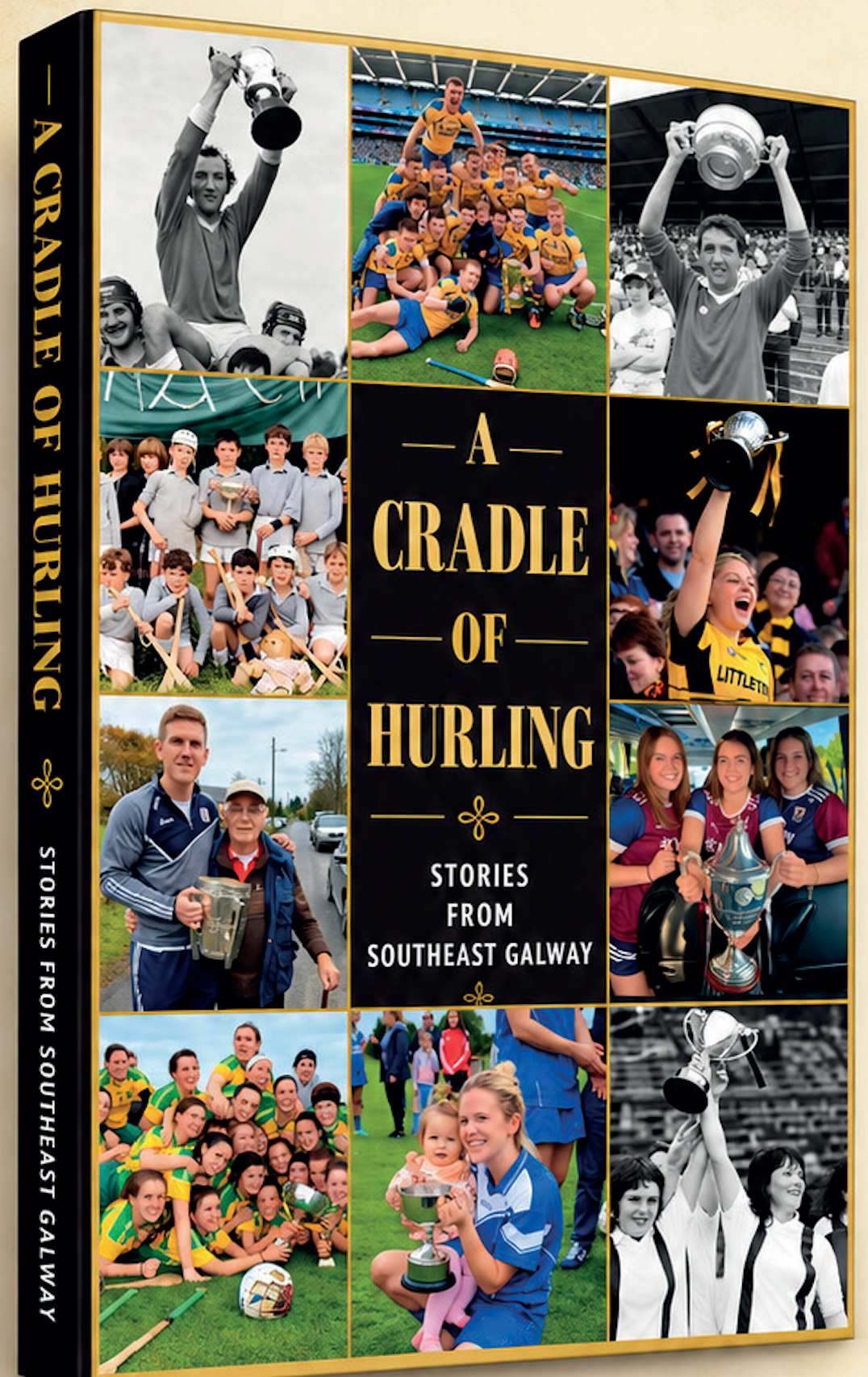
The book A Cradle of Hurling – Stories from Southeast Galway was officially launched on October 29, 2026 at Gullane’s Hotel in Ballinasloe, with the launch performed by GAA President Jarlath Burns.
About the Book & Launch
• Content: The book features 51 short stories written by 47 different local contributors, documenting over 150 years of hurling and camogie history, community life, and sporting memories across eight clubs in Southeast Galway from 1869 to 2026.
• Charity: All proceeds from the book sales go directly to Ballinasloe Social Services.
• Origin: The project began organically after a casual evening of storytelling among hurlers in Mother’s Bar, Kiltormer.
The Author / Editor
• Aidan Lenehan spearheaded and edited the collection (co-authoring alongside contributions from 46 other writers). Lenehan is a Galway author, hurler, and founder of the Wild Geese GAA club in Dublin, and has previously written works on local hurling heritage